08 May, 2026
The Wonderkids FM Predicted Before Anyone Else
From Bale to Veratti, some legends were FM icons long before they conquered reality. Discover the stars Football Manager predicted first.
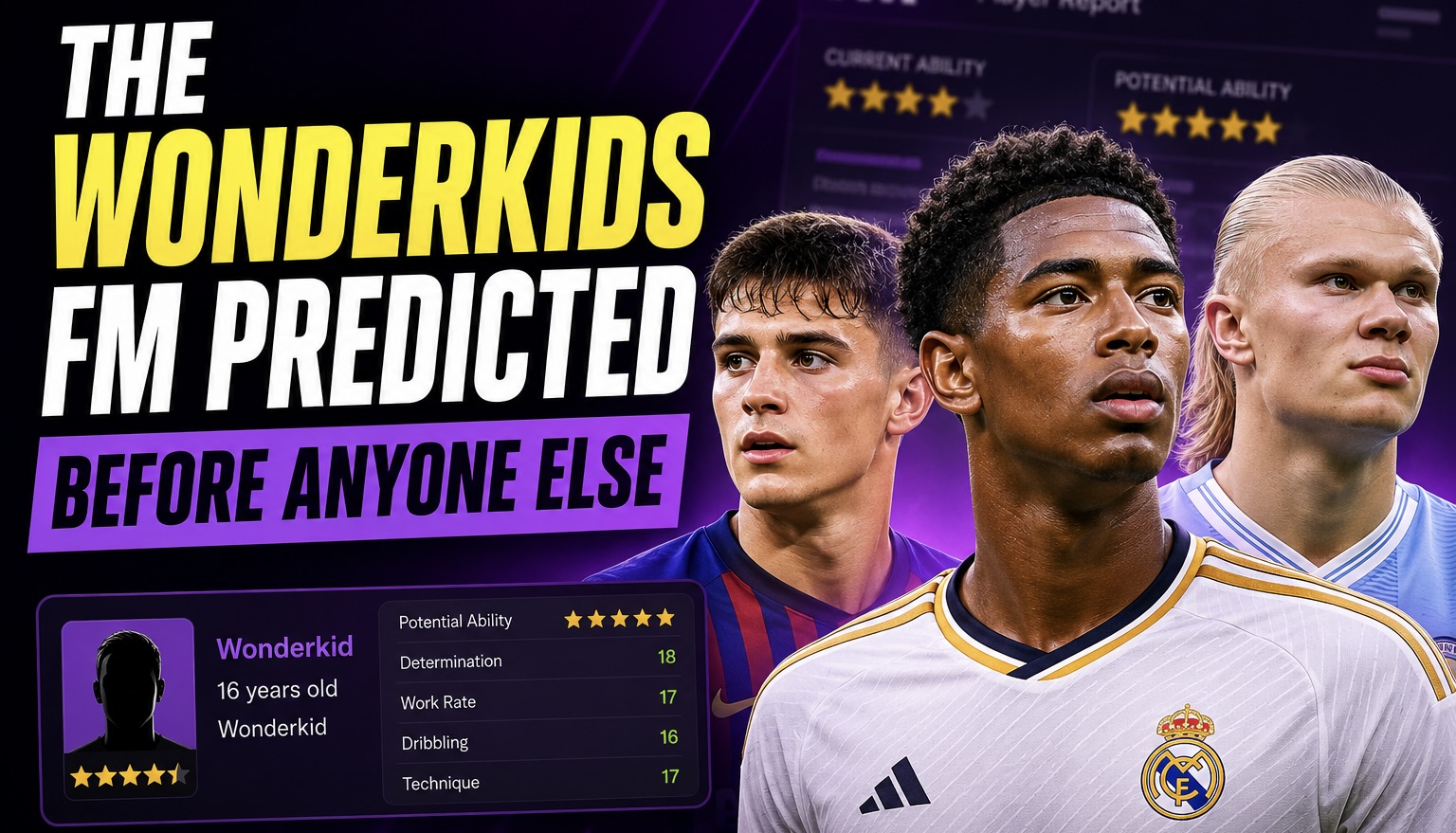
Football Manager gets a lot of credit for “discovering” players, but that claim can get very loose very quickly. Rating Lionel Messi highly when he was already being whispered about at Barcelona won’t get you any praise in today’s skeptical world. The interesting cases are different: players who were already somewhere in the database, quietly loaded with potential, before most fans had any real reason to care or know who they were. These players weren’t all complete unknowns, necessarily, because elite football clubs tend not to leave future superstars wandering around entirely unnoticed. These are players who existed in that sweet spot between serious scouting knowledge and mainstream football fame.
That is where FM’s database has always been at its most impressive. Not when it tells you Neymar is good. Anyone with eyes and access to YouTube could manage that. It is when the game is nudging you towards a teenage left-back at Southampton, a tiny midfielder in Serie B, a forward in Argentina’s second tier, or a Belgian kid at Genk before English football has decided he is worth taking seriously. These are the Football Manager wonderkids the game can make a fair claim to having spotted early.
Marco Verratti
Marco Verratti is one of the best examples in this list because there was no obvious glamour attached to the pick. FM10 was not asking you to scout Barcelona. They were telling you that a 17-year-old at Pescara, then in Serie B, could become a superb midfielder. He was listed with -9 potential, usually developing into the 170s, with the technical and mental profile you would expect from a player who later spent a decade making Champions League midfield look like five-a-side. At the time, Verratti had made his senior debut but was nowhere near mainstream European consciousness. The wider world did not really catch on until Pescara’s 2011/12 promotion season, when he became one of Italian football’s most talked-about young players and PSG arrived. That is why FM deserves a huge amount of credit. It had a small, technical midfielder in the Italian second tier marked as a high-ceiling prospect years before he became a fixture in PSG’s midfield and a European Championship winner with Italy. Every good FM save needs one player you smugly claim you knew before everyone else. Verratti was that player, except the smugness was actually justified.
Gareth Bale
Gareth Bale might be the best version of this argument because Football Manager caught him before real football had even agreed what he was. In FM07 and FM08, he was not the terrifying Real Madrid wide forward, or even the Tottenham player who would eventually ruin Maicon’s career. He was a teenage Southampton left-back, then a left-back/wing-back type at Spurs. FM circles were already talking him up in 2006 and 2007, with one blog tipping him to become the best left-back in the game and forum posts flagging him as a 17-year-old Southampton bargain with 20 free-kicks. Yes, 20. Bale’s real-life reputation at the time was still very specific. A gifted Championship teenager, rather than a future Ballon d’Or-level attacker. He had made his Southampton debut at 16 and earned his move to Tottenham in 2007, so he was not hidden in a bunker, but FM’s prediction was bigger. They saw the elite athlete, the left foot and the attacking upside before his career had caught up with the idea. By the time Bale had become a two-time PFA Player of the Year, moved to Real Madrid for around €100million and won five Champions Leagues, the teenage Southampton full-back era felt a bit absurd.
Paulo Dybala
FM12 did not have him at Juventus, Roma, Palermo or any other club that would make the pick feel obvious in hindsight. It had him at Instituto in Argentina’s second tier, aged 17, valued at around £350,000, and listed among the game’s better wonderkids. There were also SI forum mentions and FM Base profiles highlighting him. At the time, Dybala had only just started his senior career. He was a teenager in Córdoba, playing below the Argentine top flight, before Palermo brought him to Italy in 2012. The game had him marked as a future star before the casual European fan had any reason to know his name. Dybala then went from Palermo to Juventus in a deal worth up to €40million, won five Serie A titles, became Serie A MVP in 2019/20 and added a World Cup winners’ medal with Argentina in 2022. FM finding a 17-year-old Instituto forward before all that is more than just good scouting. It’s biblical levels of prophecy.
Kevin De Bruyne
Kevin De Bruyne was not invisible in Belgium, but there is a big difference between being known at Genk and being recognised as one of the best midfielders of the Premier League era. FM11 had him in that in-between stage: 19 years old, valued at around £700,000, listed by FM Scout among the wonderkids with serious potential and discussed by Sports Interactive forum users as a quick, explosive advanced midfielder at Racing Genk. In real life, he had already made his debut and was becoming important domestically, but this was before Chelsea, before Werder Bremen, before Wolfsburg, before Manchester City. FM was ahead of the Premier League audience by a long way. It saw a player worth building around while he was still part of a clever Belgian scouting conversation rather than a global one. Genk’s title-winning season, Chelsea’s move in 2012, the Bundesliga breakout and the Manchester City years all came later. By the time he was winning Premier League titles and Champions Leagues under Pep Guardiola, the old FM11 listing looked like a very sharp early read.
Robert Lewandowski
Robert Lewandowski is a more complicated case. FM did not perfectly predict the monster who would one day score 100 Champions League goals and make elite centre-forward play look almost boringly repeatable. But it did know there was something there before most fans outside Poland had much reason to. In FM09 and FM10, Lewandowski was at Lech Poznań, appearing in bargain striker discussions and wonderkid lists, with one old SI forum thread calling him a striker available for roughly £1million and suggesting you would not believe how good he became. FM2010 lists gave him a 165 potential rating. That feels about right. He was not a guaranteed save-breaking alien, but he was a proper prospect in a league most English players barely touched unless they were doing an obscure Eastern European recruitment phase. In real life, Lewandowski was emerging at Lech, not leading the line for Dortmund, Bayern or Barcelona. Dortmund came next, then Bayern, then the Champions League, the Bundesliga records, the Ballon d’Or arguments etc. FM gets credit here, but with a caveat: it saw a high-level striker before the mainstream did, but real life ended up overshooting even the most optimistic database version.
Son Heung-min
Son Heung-min’s FM reputation was built before the Tottenham version of him existed. In FM11 and FM12, he was a young Hamburg forward rather than the Premier League Golden Boot winner who would eventually become one of the best Asian footballers ever. FM12 high-potential lists had him among the strong under-21 prospects, while FM-Base profiles picked out his pace, acceleration, finishing, off-the-ball movement, technique and long shots. In other words, the game had already clocked the outline: speed, sharp movement, clean ball-striking, and a forward profile that could become much more than a Bundesliga prospect. In real life, Son had gone to Germany young and was breaking through at Hamburg, but he was not yet a major European name. Leverkusen came in 2013, Tottenham in 2015, and from there the curve went far higher than most neutral fans would have expected when he was still in Hamburg red. He became a Spurs captain, a 100-goal Premier League player, a Golden Boot winner and one of the great wide forwards of his era.
James Rodríguez
James Rodríguez was already a serious South American prospect, not some completely anonymous teenager generated by the database gods. But he was not yet the James of the 2014 World Cup, the Golden Boot, the volley against Uruguay, the Real Madrid move and the global celebrity that followed. FM10 had him at Banfield as an 18-year-old attacking midfielder available for under £1million, with forum users calling him brilliant and cheap. By FM11, he was at Porto and appearing in wonderkid lists as a 19-year-old left-sided creator. He was not unknown to sharp scouts, but nowhere near mainstream European fame. FM deserves credit because it made him feel like a must-buy before the wider football audience had processed him after that goal for Colombia at the World Cup. The move to Porto, the Monaco transfer, the Brazil 2014 explosion and the Real Madrid deal turned him into one of the most recognisable attacking midfielders in the world. Looking back, FM did not beat South American scouting to him, and it would be silly to pretend otherwise. But for the average player sitting in Britain in 2010, James wasn’t exactly a household name yet.
So, who did FM really get right?
The strongest cases are Bale, Verratti and Dybala. Bale because FM saw superstar traits in a teenage left-back before football had worked out his final form. Verratti because it rated a tiny Serie B midfielder as an elite prospect before PSG made him a European name. Dybala because a 17-year-old at Instituto is exactly the kind of player most fans would never have found without the game putting a little digital spotlight on him.
De Bruyne, Son, Lewandowski and Modric are only slightly behind. They were not complete secrets, but FM was ahead of mainstream football culture, especially in Britain.
Football Manager did not have a crystal ball. It had a huge research network, a willingness to take young players seriously outside the obvious markets, and enough database confidence to make some of them feel special before their careers had proved it. Sometimes it got carried away. Sometimes it created legends who spent the next decade bouncing between Belgium, Turkey and beyond. But every now and then, it looked at a teenager in Southampton, Pescara or Córdoba and saw the future more clearly than most of us did.
Check out our Feature Articles section for more FM26 Updates and Tips.