04 Jun, 2026
Recreating England’s 2026 World Cup Tactic on Football Manager
We recreated England’s 2026 World Cup tactics in Football Manager. Does this tactic have what it takes to go all the way?
This piece is inspired by John Walker’s incredible tactical analysis of England. Seriously, you need to check out his thread on every team at the World Cup, it’s impressive. Once I had watched the video, it got me thinking, what if we could completely faithfully replicate Thomas Tuchel’s England tactic on FM26?
John’s video
In the video John highlighted both the strengths and flaws of England’s qualifying campaign. which had a perfect record on paper but is a team still searching for a clear attacking identity before the tournament. England’s qualifying campaign looked almost flawless. They won every game and did not concede. However, the footage tells a slightly different story. This is not an England side that looks best when it slowly squeezes teams to death with long spells of sterile possession. Their strongest moments come when the game opens up. When the ball is played forward quickly and Bukayo Saka and Marcus Rashford can isolate full-backs. When Jude Bellingham can arrive between lines. When Harry Kane can drop off, link play and still be the player attacking the final ball.
So the aim of this FM26 tactic is not to create the most dominant possession system possible. It is to recreate the version of England that looks most dangerous from the analysis.
The starting XI
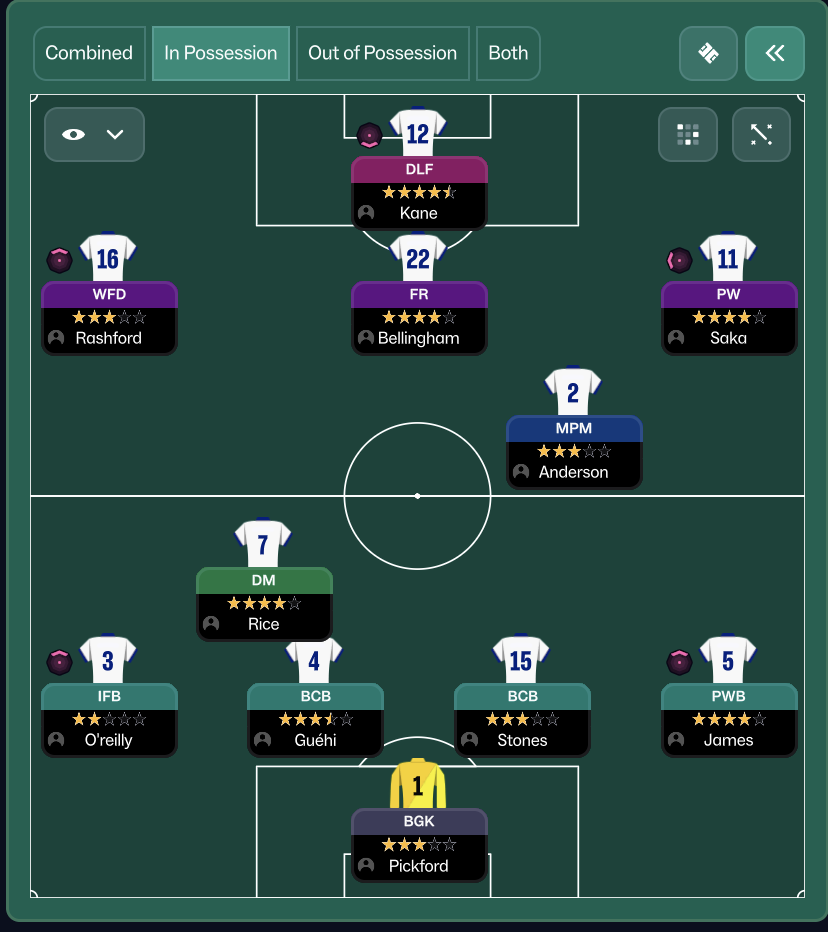
The strongest XI in this setup is:
GK: Jordan Pickford
RB: Reece James
RCB: John Stones
LCB: Marc Guéhi
LB: Nico O’Reilly
DM: Declan Rice
CM: Elliot Anderson
LW: Marcus Rashford
AM: Jude Bellingham
RW: Bukayo Saka
ST: Harry Kane
What this system needs is recovery pace, set-piece delivery, wide threat and enough discipline behind the ball to avoid transition gaps.
Combined shape
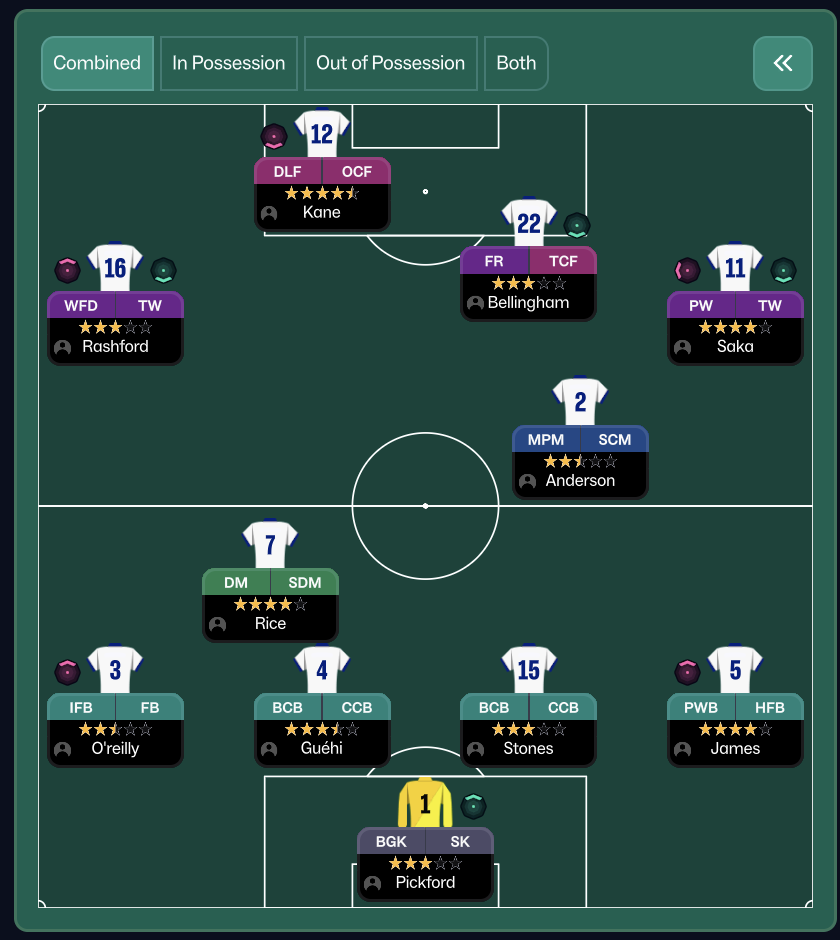
On paper, this is a 4-2-3-1. In possession, Kane leads the line, Bellingham plays underneath him, Saka and Rashford stretch the pitch, Rice anchors midfield, and Anderson plays as the connector.
Out of possession, it becomes closer to a 4-4-2. Kane and Bellingham are the first line. Rashford and Saka drop into wider midfield positions. Rice and Anderson sit behind them. The back four holds a standard line rather than pushing ridiculously high.
England repeatedly have the same weakness. England’s press can become too eager and too disconnected. The front players jump, the midfield does not always recover quickly enough and opponents can find passes behind or through the press. So, the goal with this tactic is not to turn England into a passive low block… but the shape cannot be a reckless high press either.
Jordan Pickford
Pickford’s in-possession role gives England a clean first pass into Stones or Guéhi without forcing them to build slowly. The tactic is direct, but not random. Pickford can still start attacks properly before England go forward at speed. Out of possession, the Sweeper Keeper role suits the standard line. Pickford needs to be alert to balls in behind when the press is triggered (without being suicidally high.
Reece James
James is a Playmaking Wing-Back because he can create from deeper areas, combine with Saka, and deliver early crosses into Kane and Bellingham. Whilst, also being able to overlap. Out of possession, Holding Full-Back keeps him disciplined. England need his quality on the ball, but they cannot afford both full-backs flying forward when their main concern is transition defending.
John Stones & Marc Guéhi
Stones and Guéhi are both Ball-Playing Centre-Backs in possession because England need clean progression from the back. Stones gives the stronger right-sided route into James, Anderson, Saka or Kane, while Guéhi provides a calmer left-sided option so England do not become predictable. Out of possession, both become Covering Centre-Backs. That directly addresses England’s main weakness. England can leave space behind the press when the front players and midfield jump. Their job is to protect depth, read danger early and stop direct balls or runners turning into clean chances against Pickford.
Nico O’Reilly
Nico O’Reilly inverts in possession to balance Rashford’s direct role. It’s a role he’ll be familiar playing under Pep Guardiola. With Rashford staying high and aggressive, Nico O’Reilly moves inside gives England extra protection near Rice and Anderson.
Out of possession, he returns to a normal Full-Back role. England still need him defending the left side of the 4-4-2 block rather than acting like an extra midfielder all the time.
Declan Rice
Rice is the holding player in possession. He gives England a stable base behind Bellingham, Saka, Rashford and Kane, allowing the attacking players to be aggressive without leaving the centre completely exposed. Out of possession, Screening Defensive Midfielder is essential. John’s video highlighted England’s vulnerability when teams break quickly through midfield, so Rice’s job is to block central lanes and protect the centre-backs.
Elliot Anderson
Anderson is the Midfield Playmaker because England need a second midfielder who can receive, connect and move the ball forward without turning the double pivot into two holders. Out of possession, he becomes a Screening Centre Midfielder. That keeps him close enough to Rice to stop the gap between midfield and attack becoming too big.
Bukayo Saka
Saka is a Playmaker Winger because England’s right side should run through his decision-making, rather than his pace. He can hold width, combine with James and Bellingham, carry inside or create the final action. Out of possession, Tracking Winger is the best fit. It keeps him attached to England’s 4-4-2 defensive shape while still allowing him to press and recover. England’s press has easily become disconnected; so Saka has to help lock the right side down, not just wait high for counters.
Marcus Rashford
Rashford is a Wide Forward because Tuchel wants him attacking space. England are most dangerous when their wide players can drive 1v1 and run beyond Kane. Out of possession, he is turned as a Tracking Winger for the same reason as Saka.
Jude Bellingham
Bellingham gets a Free Role in possession because England need his movement, timing and ball-carrying more than a fixed number ten. He can link with Kane, arrive in the box, or drift towards Saka to overload the right side. Out of possession, he’s a Tracking Centre Forward. It keeps him next to Kane in the 4-4-2 press, but with more defensive responsibility. Bellingham has to help close passing lanes, press intelligently and recover into shape rather than simply staying high.
Harry Kane
Kane is the Deep-Lying Forward in possession because England’s best attacks can start with him receiving early and bringing runners into play. Rashford, Saka and Bellingham all benefit from Kane dropping short and playing forward quickly. It helps when you’re the best centre forward in the world and probably one of the best of all time at doing this.
Out of possession, Central Outlet Centre Forward is exactly his job. He gives England a central reference point after regains, allowing them to counter quickly without asking him to chase defenders or run channels constantly.
In possession instructions
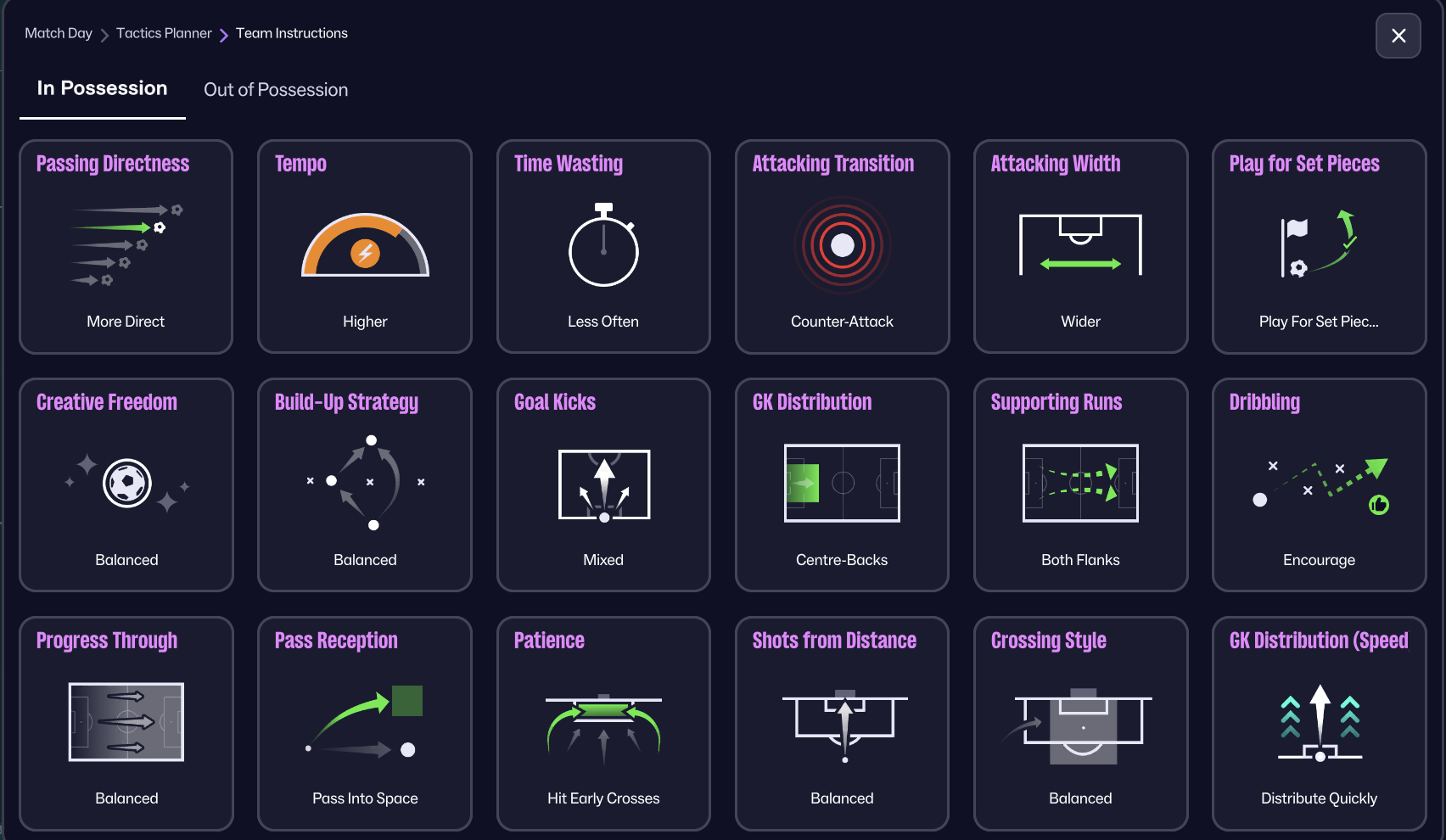
- Passing Directness: More Direct
- Tempo: Higher
- Attacking Transition: Counter-Attack
- Attacking Width: Wider
- Supporting Runs: Both Flanks
- Pass Reception: Pass Into Space
- Patience: Hit Early Crosses
- Dribbling: Encourage
- Play For Set Pieces: On
- GK Distribution: Centre-Backs, Distribute Quickly
England had the second-highest average possession in European qualifying, but they often looked better when they moved the ball forward quicker. That is why the system uses higher tempo, more direct passing and pass into space.
Making them attack wider is because Rashford and Saka need room to isolate defenders. If England become too narrow, they end up congesting Kane and Bellingham’s space. Width stretches the back line and creates the lanes for underlaps, early crosses and cut-backs.
“Hit early crosses” is perfect because Kane is one of the best centre-forwards in the world at attacking deliveries, while Bellingham is elite at arriving into dangerous areas. England do not need 25 passes before they put the ball into the box. They have the players to hurt teams earlier.
The set-piece instruction is non-negotiable. Over a third of England’s qualifying goals came from set pieces and penalties, with only 12 open-play goals. With Rice and Saka on delivery, plus Kane, Stones, Guéhi and Bellingham attacking the box, set plays should be a major weapon.
Out of possession instructions
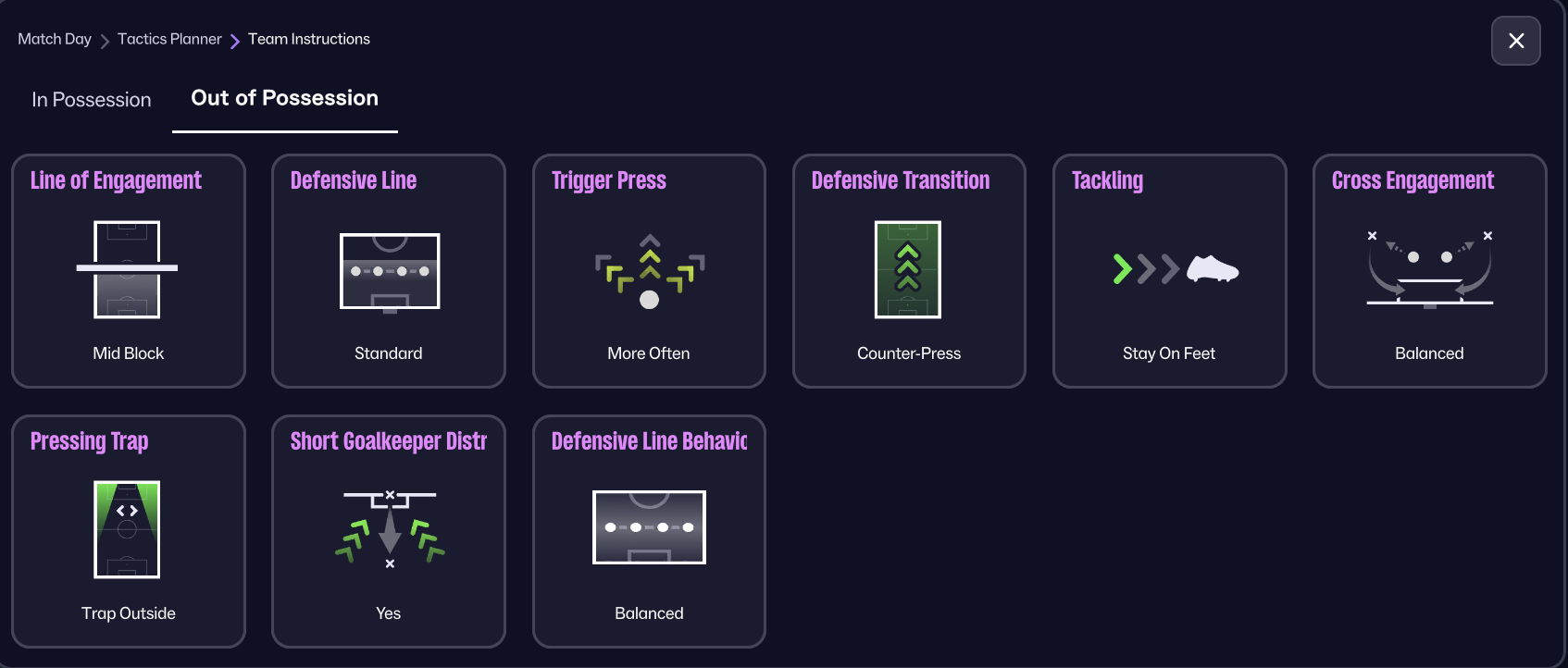
The out-of-possession setup is:
Line of Engagement: Mid Block
Defensive Line: Standard
Trigger Press: More Often
Defensive Transition: Counter-Press
Tackling: Stay On Feet
Pressing Trap: Trap Outside
Short Goalkeeper Distribution: Yes
Defensive Line Behaviour: Balanced
Cross Engagement: Balanced
John’s analysis shows England pressing in a 4-4-2 shape, but also highlights how easily that press can become disjointed. A higher line and maximum press would probably make that worse in FM26. You would get Kane, Bellingham, Saka and Rashford jumping onto defenders, then Rice and Anderson having to cover too much ground behind them.
That is why this is a mid block, not a full-throttle gegenpress.
England still press more often, because they have the athletes and forwards to do it. But the standard defensive line and balanced behaviour stop the team becoming stretched. Having the players “Stay on feet” because England cannot afford cheap fouls or rash tackles when the whole point is to stay compact and counter quickly.
The pressing trap is set outside because this squad is better equipped to defend wide channels than huge central gaps. Rice, Anderson, Stones and Guéhi can protect the middle, while Saka, Rashford, James and the left-back can engage wide. Force opponents around the block, then break quickly when the ball is won.
Why this is not a pure possession
The tempting thing with England is to build a technical 4-3-3 or 4-2-3-1 and try to dominate every match. The squad has enough talent to do that against weaker opposition.
But tournament football is not only about talent. It is about where your weaknesses appear against better sides.
England can be vulnerable when they lose the ball with too many players ahead of it. Japan and Senegal are both clear examples of opponents exposing those transition spaces. That flaw would become fatal in a World Cup knockout game.
So this tactic accepts what England are. They are not Spain. They are a side with elite attacking runners, one of the world’s best forwards, dangerous set pieces and enough defensive quality to be very hard to break down once organised.
The priority is to get into that organised shape quickly, win the ball, and attack before opponents are ready.
The final verdict
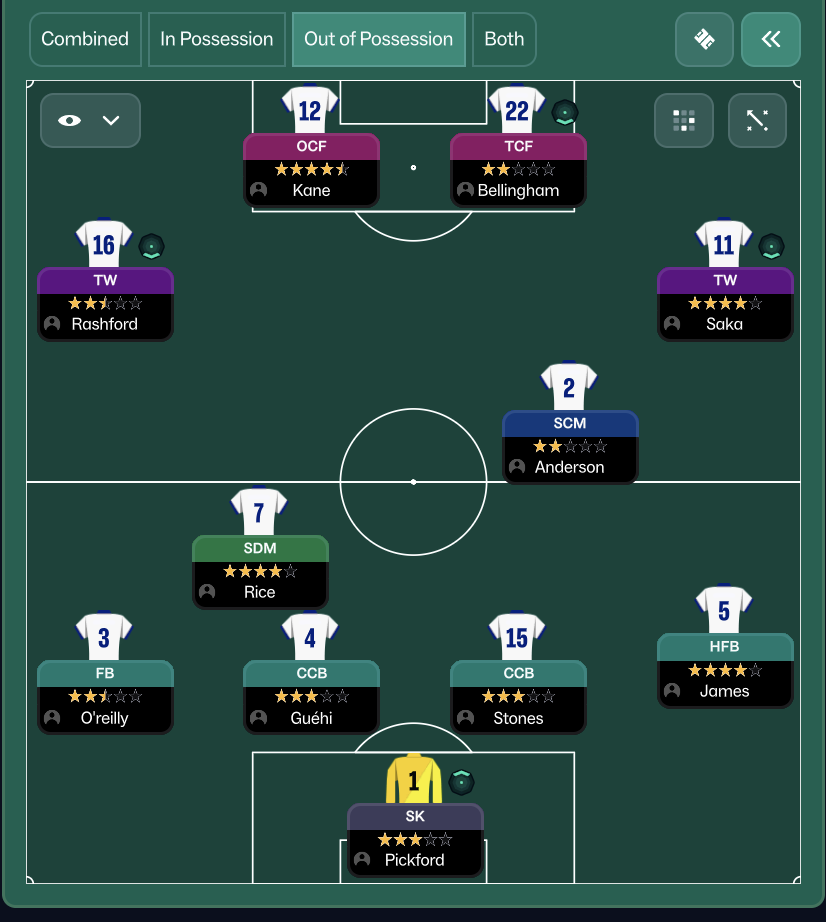
This England tactic is a 4-2-3-1 on the team sheet, a 4-4-2 without the ball, and a direct transition system in practice.
It gives Kane the freedom to link play without removing him from the box. It gives Bellingham room to be a match-winner. It gives Saka and Rashford the licence to attack defenders. It protects Rice from having to cover the entire midfield alone. And it leans into England’s set-piece threat, which could be one of their biggest weapons at the tournament.
Based on the tactical evidence, it is probably closer to the version of England that can actually hurt elite teams.
Check out our Feature Articles for more World Cup and Football Manager Content.