04 Jun, 2026
Ranking Each World Cup Teams MD1 & MD2 Fixture Difficulty.
Who has a dream start and whose already doomed? See our complete ranking of all 2026 World Cup team fixtures across Matchday 1 and Matchday 2.
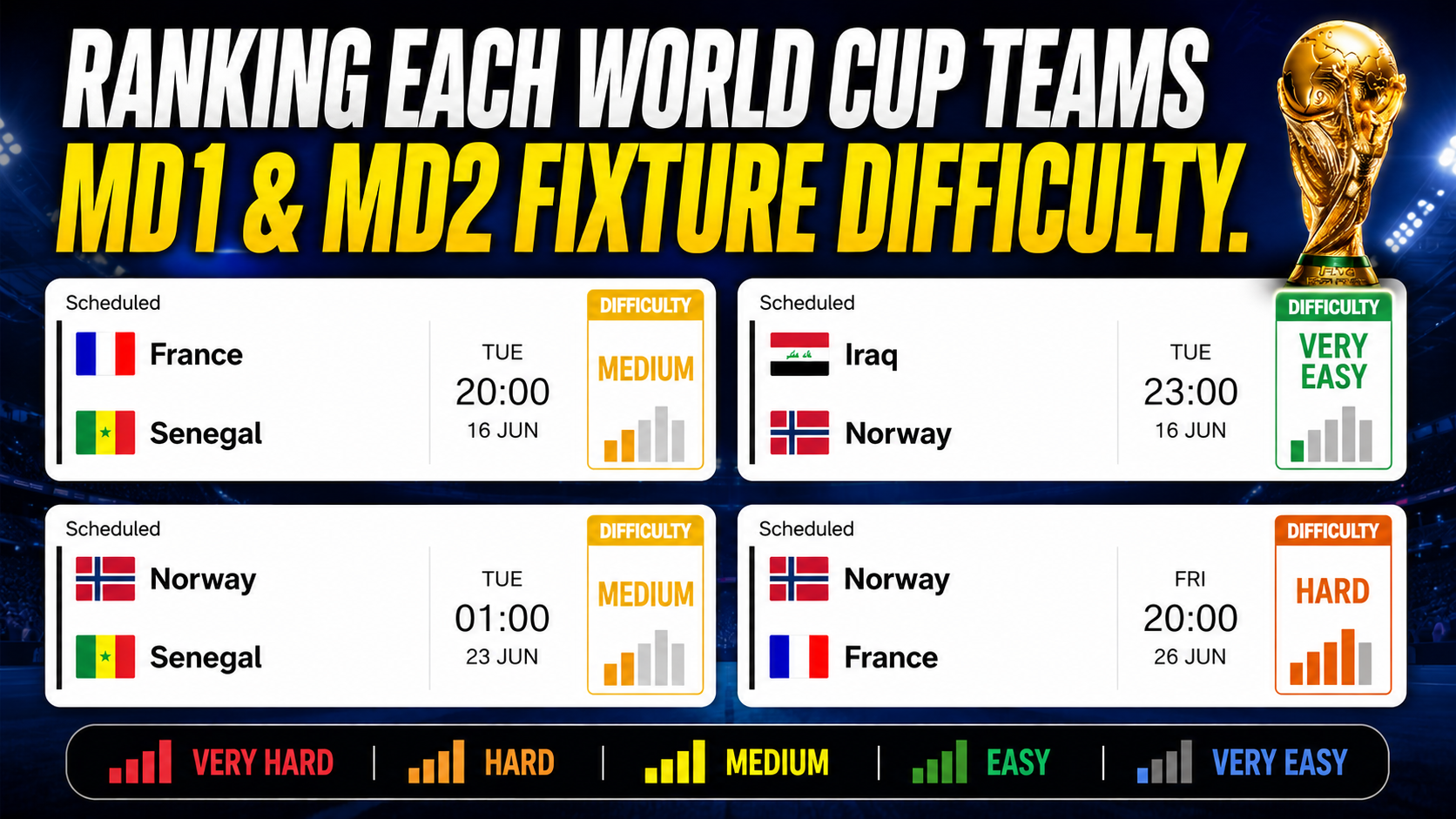
The draw is complete, but not all opening schedules are created equal.
To measure the difficulty of every team’s first two group-stage matches (MD1 and MD2), I created a custom ranking model using all 48 qualified nations, with France ranked No. 1 as the strongest team in the tournament and Curaçao ranked No. 48.
For Fantasy World Cup managers, these rankings become particularly relevant when considering chip strategy. Assuming most managers deploy their Wildcard ahead of Matchday 3, only the first two group-stage fixtures truly matter when building an initial squad.
Of course, this is not simply a list of teams with the best fixtures. A favourable schedule only becomes useful if the players themselves are capable of taking advantage of it. The goal is to identify where fixture quality and player quality overlap. Spain may have the easiest opening fixtures in the tournament, but that only becomes meaningful because they also possess some of the best fantasy assets available.
Before we get started, check out our Best Players to Own for World Cup Fantasy, as well as our Best Differentials under 5% ownership piece for more ways to get ahead.
| Rank | Team | Score |
|---|---|---|
| 1 | Spain | 95 |
| 1 | Uruguay | 95 |
| 3 | Canada | 93 |
| 3 | Switzerland | 93 |
| 5 | Belgium | 84 |
| 5 | New Zealand | 84 |
| 7 | Germany | 81 |
| 7 | Ecuador | 81 |
| 9 | United States | 70 |
| 9 | Turkey | 70 |
| 11 | France | 66 |
| 11 | Norway | 66 |
| 13 | Portugal | 64 |
| 13 | Colombia | 64 |
| 15 | Brazil | 61 |
| 15 | Scotland | 61 |
| 17 | Mexico | 57 |
| 17 | Czech Republic | 57 |
| 19 | Argentina | 54 |
| 19 | Jordan | 54 |
| 21 | Croatia | 54 |
| 21 | Ghana | 54 |
| 23 | Bosnia-Herzegovina | 53 |
| 23 | Qatar | 53 |
| 25 | Japan | 51 |
| 25 | Sweden | 51 |
| 25 | Netherlands | 51 |
| 25 | Tunisia | 51 |
| 29 | Algeria | 49 |
| 29 | Austria | 49 |
| 31 | Egypt | 48 |
| 31 | Iran | 48 |
| 33 | South Africa | 47 |
| 33 | South Korea | 47 |
| 35 | England | 45 |
| 35 | Panama | 45 |
| 37 | Morocco | 40 |
| 37 | Haiti | 40 |
| 39 | Paraguay | 35 |
| 39 | Australia | 35 |
| 41 | Curaçao | 24 |
| 41 | Ivory Coast | 24 |
| 43 | Cape Verde | 22 |
| 43 | Saudi Arabia | 22 |
| 45 | Congo | 18 |
| 45 | Uzbekistan | 18 |
| 47 | Senegal | 12 |
| 47 | Iraq | 12 |
How the Model Works

The system begins with the custom ranking of all 48 teams.
Each nation’s opening two opponents are assigned their ranking value and added together to create a fixture score.
For example:
- Iraq face Norway (9th) and France (1st)
- Iraq’s score = 9 + 1 = 10
Meanwhile:
- Spain face Cape Verde (45th) and Saudi Arabia (39th)
- Spain’s score = 45 + 39 = 84
Because higher ranking numbers belong to weaker teams, a higher score represents an easier set of fixtures.
Under this original method, Spain and Uruguay recorded the easiest opening schedules, while Senegal and Iraq received the toughest.
For fantasy managers, that already provides a useful starting point. If most squads are going to be rebuilt on a Matchday 3 Wildcard, then only the first two fixtures truly matter. However, the model was then refined further.
How I Did The Original Rankings
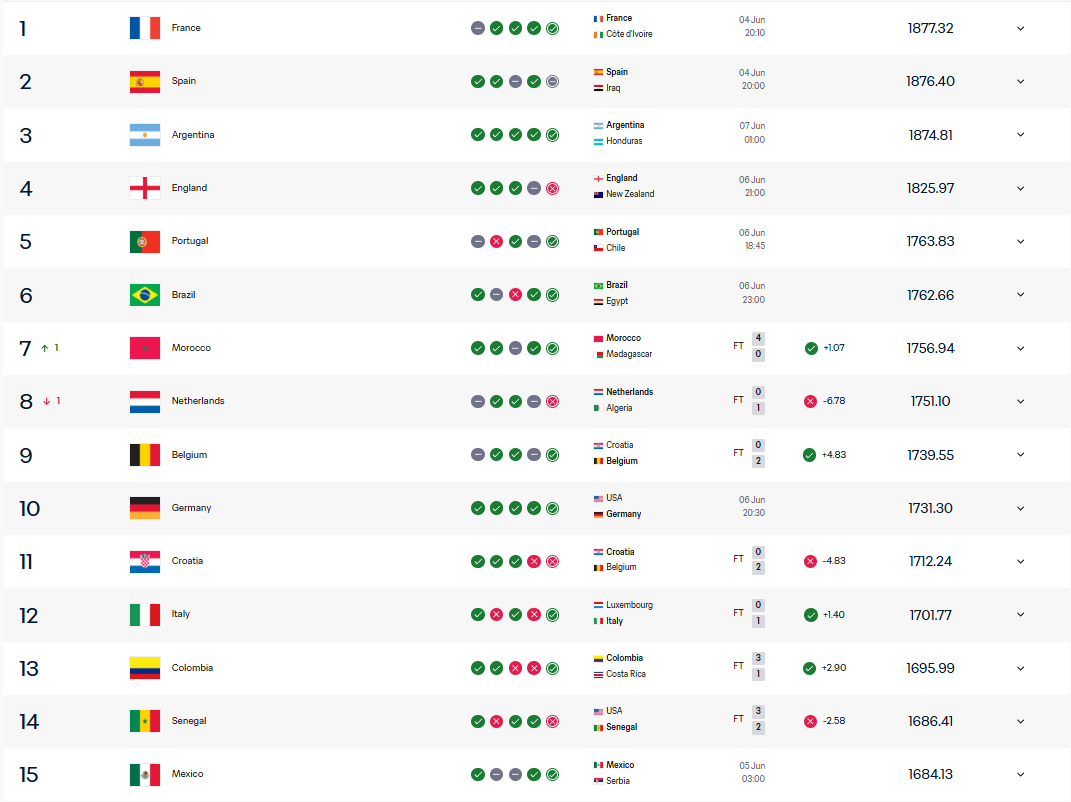
The first thing I did was Stay as far away from the FIFA Rankings as possible. All it takes is one look to realise how poor a metric they can be.
Instead, I based the rankings on a combination of qualifying performances, squad quality, tournament pedigree, recent results and, ultimately, my own judgement.
Naturally, there will be plenty of rankings that people disagree with. Football is subjective, and if everyone ranked the teams exactly the same, there would be little point doing it in the first place. So if your nation is higher or lower than you expected, please understand this is just my opinion and cases can be made for every nation.
The rankings themselves are not intended to predict exactly how the tournament will play out. Rather, they provide a framework for comparing the quality of the opposition each team will face during the opening two matchdays.
Introducing Tier Weighting
One limitation of a straight ranking system is that it can understate the gap between elite teams and everyone else.
For example, the difference between Portugal (4th) and Netherlands (8th) is only four places numerically, despite the fact that both nations sit in different tiers of contention.
To better reflect real-world strength differences, the rankings were divided into seven tiers.
Each team receives a bonus based on the tier they belong to.
The lower the tier, the larger the bonus.
Examples
- France = 1 + 0 = 1
- Germany = 7 + 1 = 8
- Norway = 9 + 2 = 11
- Mexico = 19 + 3 = 22
- Paraguay = 28 + 4 = 32
- New Zealand = 38 + 5 = 43
- Curaçao = 48 + 6 = 54
The same fixture calculation is then repeated using these adjusted values.
Example
Before tier weighting:
Spain’s opponents:
- Cape Verde = 45
- Saudi Arabia = 39
Score:
45 + 39 = 84
After tier weighting:
- Cape Verde = 51
- Saudi Arabia = 44
Adjusted score:
51 + 44 = 95
The effect is to create greater separation between teams facing elite opposition and those facing nations from the lower tiers.
From a fantasy perspective, this is important because it better reflects the likelihood of returns. There is a significant difference between facing France and facing a bottom-tier nation, and the weighting system attempts to capture that gap.
The Full Rankings with Tiers
Tier 1 (+0)
1. France
2. Spain
3. England
4. Portugal
5. Argentina
6. Brazil
Tier 2 (+1)
7. Germany
8. Netherlands
Tier 3 (+2)
9. Norway
10. Belgium
11. Colombia
12. Croatia
13. Turkey
14. Ecuador
15. Switzerland
16. Senegal
17. Morocco
18. Uruguay
Tier 4 (+3)
19. Mexico
20. United States
21. Austria
22. Sweden
23. Japan
24. Ivory Coast
25. Czech Republic
26. South Korea
27. Ghana
Tier 5 (+4)
28. Paraguay
29. Congo
30. Scotland
31. Algeria
32. Uzbekistan
33. Canada
34. Australia
35. Egypt
36. Bosnia-Herzegovina
37. South Africa
Tier 6 (+5)
38. New Zealand
39. Saudi Arabia
40. Iran
41. Tunisia
Tier 7 (+6)
42. Iraq
43. Jordan
44. Haiti
45. Cape Verde
46. Panama
47. Qatar
48. Curacao
Spain and Uruguay Land Dream Starts

After applying the tier-adjusted model, Spain and Uruguay emerge with the most favourable opening schedules in the tournament.
Both nations finish with a fixture score of 95, comfortably clear of most of the field.
Their first two opponents come from the lower tiers of the rankings, giving both teams an ideal opportunity to establish control of their groups before the decisive final matchday.
Canada and Switzerland are close behind on 93, while Belgium and New Zealand also receive highly favourable starts.
Top 10 Easiest Opening Schedules
- Spain – 95
- Uruguay – 95
- Canada – 93
- Switzerland – 93
- Belgium – 84
- New Zealand – 84
- Germany – 81
- Ecuador – 81
- United States – 70
- Turkey – 70
For fantasy managers, this is where the rankings become particularly useful.
Spain stand out as the obvious target. They combine elite player quality with the easiest opening fixtures in the tournament. Germany and Belgium also look appealing because they offer a similar blend of strong assets and favourable opponents.
KEY TIP: Tier 3 countries with elite fixtures ,like Ecuador and Switzerland, will be excellent for defenders but less good for attackers given the way they set up. So always makes sure you look into the teams themselves before deciding which assets to target.
Although Canada and New Zealand rank extremely highly from a fixture perspective, managers still need to consider whether their players possess the same fantasy upside as assets from Spain, Germany or Belgium. As good fixtures don’t matter if your team itself isn’t that good either.
Fixture quality should be employed as a secondary metric to team quality.
Senegal and Iraq Face the Tournament’s Toughest Opening Test
At the opposite end of the scale, Senegal and Iraq receive the harshest possible introduction to the World Cup.
Both nations record a score of just 12 after drawing France and Norway in their opening two fixtures.
Not only are they facing two teams ranked inside the top ten, but both opponents also sit within the strongest tiers of the rankings, creating the largest possible difficulty penalty.
Top 10 Hardest Opening Schedules
- Senegal – 12
- Iraq – 12
- Congo – 18
- Uzbekistan – 18
- Saudi Arabia – 22
- Cape Verde – 22
- Curaçao – 24
- Ivory Coast – 24
- Paraguay – 35
- Australia – 35
Congo and Uzbekistan are similarly unfortunate after drawing Portugal and Colombia, while Saudi Arabia and Cape Verde must navigate fixtures against Spain and Uruguay.
From a fantasy standpoint, these teams are likely to be avoided almost entirely anyway. Even talented players can struggle to produce returns when faced with elite opposition in consecutive matches.
That does not necessarily mean every player should be ignored, but it raises the threshold required to justify selecting them.
Biggest Winners and Losers from the Tier System
The introduction of tier weighting widened the gap between favourable and unfavourable draws.
Biggest Winners
- Spain
- Uruguay
- Canada
- Switzerland
- Belgium
- New Zealand
These teams benefited because their opponents are concentrated in the lower tiers, causing their fixture scores to rise significantly once weighting was introduced.
Biggest Losers
- Senegal
- Iraq
- Congo
- Uzbekistan
- Saudi Arabia
- Cape Verde
These nations were hit hardest because their opponents belong to the strongest tiers in the tournament.
The tier system effectively amplifies the punishment for drawing elite opposition and rewards teams that avoid the tournament’s biggest contenders.
The Complete Fixture Difficulty Rankings
| Rank | Team | Score |
|---|---|---|
| 1 | Spain | 95 |
| 1 | Uruguay | 95 |
| 3 | Canada | 93 |
| 3 | Switzerland | 93 |
| 5 | Belgium | 84 |
| 5 | New Zealand | 84 |
| 7 | Germany | 81 |
| 7 | Ecuador | 81 |
| 9 | United States | 70 |
| 9 | Turkey | 70 |
| 11 | France | 66 |
| 11 | Norway | 66 |
| 13 | Portugal | 64 |
| 13 | Colombia | 64 |
| 15 | Brazil | 61 |
| 15 | Scotland | 61 |
| 17 | Mexico | 57 |
| 17 | Czech Republic | 57 |
| 19 | Argentina | 54 |
| 19 | Jordan | 54 |
| 21 | Croatia | 54 |
| 21 | Ghana | 54 |
| 23 | Bosnia-Herzegovina | 53 |
| 23 | Qatar | 53 |
| 25 | Japan | 51 |
| 25 | Sweden | 51 |
| 25 | Netherlands | 51 |
| 25 | Tunisia | 51 |
| 29 | Algeria | 49 |
| 29 | Austria | 49 |
| 31 | Egypt | 48 |
| 31 | Iran | 48 |
| 33 | South Africa | 47 |
| 33 | South Korea | 47 |
| 35 | England | 45 |
| 35 | Panama | 45 |
| 37 | Morocco | 40 |
| 37 | Haiti | 40 |
| 39 | Paraguay | 35 |
| 39 | Australia | 35 |
| 41 | Curaçao | 24 |
| 41 | Ivory Coast | 24 |
| 43 | Cape Verde | 22 |
| 43 | Saudi Arabia | 22 |
| 45 | Congo | 18 |
| 45 | Uzbekistan | 18 |
| 47 | Senegal | 12 |
| 47 | Iraq | 12 |
What the Rankings Tell Us
This model does not attempt to predict who will qualify.
A favourable draw does not guarantee progression, and a difficult draw does not guarantee elimination.
Instead, the rankings measure one specific thing: the relative difficulty of each nation’s opening two matches.
For fantasy managers, that makes them particularly relevant. If the majority of managers are planning to activate a Wildcard before Matchday 3, then these are effectively the only fixtures that matter when constructing an initial squad.
That does not mean loading up on every player from Spain, Uruguay or Canada. Team quality, player quality, minutes, penalties, set pieces and attacking involvement still matter enormously.
However, when deciding between two similarly priced players, fixture quality can be the deciding factor.
By combining a custom world ranking with a tier-weighting system, the analysis creates a clearer distinction between drawing elite contenders and drawing lower-ranked opposition.
The result is a tournament landscape in which Spain and Uruguay appear to have received the kindest possible opening schedules, while Senegal and Iraq face a daunting challenge from the very first whistle.
Whether those advantages ultimately translate into qualification remains to be seen, but according to the numbers, some teams have already won the draw long before a ball has been kicked.
Check out our World Cup section for more Fantasy World Cup insights.