18 Jan, 2026
FM26’s Troubled Launch Could Cost SEGA up to $40 million – Says Finance Expert
A $40 million disaster? 📉 A finance expert breaks down why the FM26 launch could be a massive blow to SEGA’s bottom line and future plans.
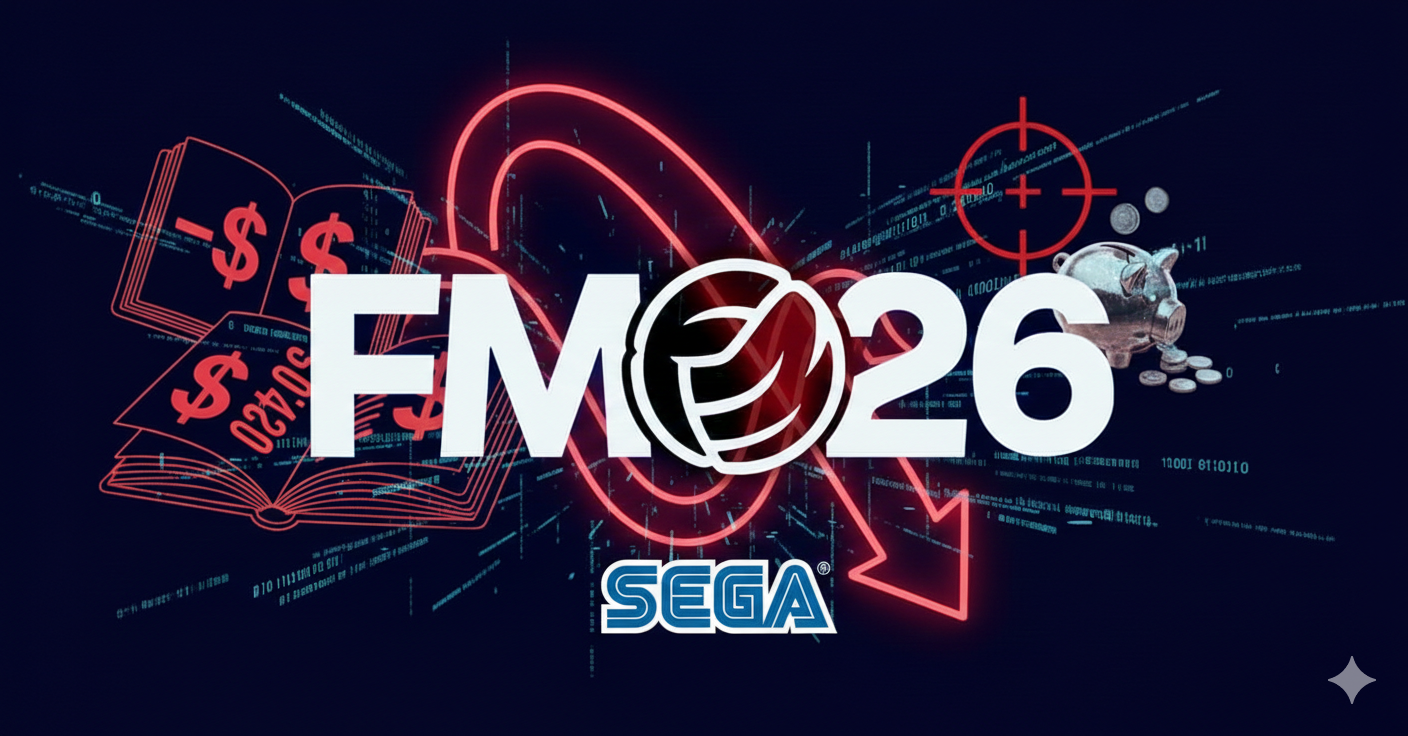
Football Manager 2026 was always going to be judged differently.
After the cancellation of Football Manager 25, this year’s release carried the weight of a missed cycle, higher expectations, and increased investment behind the scenes. According to one gaming finance analyst however, that combination means FM26’s difficult launch is not just a reputational problem, it could translate into a financial hit. Of up to $40 million for SEGA and Sports Interactive.
That figure comes from Professor Rob Wilson, a video game finance expert who spoke to The Action Network in an interview later reported on by Operation Sports. Both authors come to the same conclusion: FM26’s reception, paired with the lost momentum of a skipped annual release, has created one of the most commercially risky moments in the franchise’s history.
Where the $30/40 million estimate comes from
In his interview with The Action Network, Wilson explains that the projected losses are not based on a single factor such as review scores, but on several revenue pressures stacking on top of one another.
The first is lower sales volume. Football Manager traditionally benefits from a reliable core audience that buys early each year. When a launch is met with widespread hesitation, particularly following heavy criticism on Steam, that predictable early surge weakens.
Secondly, Wilson points to refunds and early discounting. A poor launch often forces publishers to reduce prices sooner than planned in order to stimulate sales, reducing the average revenue per copy. Refunds compound that effect by directly reversing transactions already made.
There is also the issue of reduced secondary spending. With fewer players sticking with the game, income from optional tools and add-ons is likely to fall as well, further dragging down total revenue for the year.
Taken together, Wilson estimates these combined effects could place the financial impact on SEGA in the region of $30/40 million during the current fiscal period, not catastrophic for a publisher of SEGA’s size, but significant enough to demand attention at senior level.
It’s worth stressing that this doesn’t even account for the biggest financial impact – the impact that a reduction in reputation will have on future games. If it’s just $40 million for this game, it could be a lot more in the long-term future.
Why FM25’s cancellation matters financially
A key point running both articles make is that FM26’s launch cannot be viewed in isolation.
As Operation Sports highlights, the cancellation of Football Manager 25 effectively created a “lost year” for the series. Development costs were still incurred, licensing investments continued, but the usual annual revenue stream did not arrive.
That puts additional pressure on FM26 to perform strongly, not merely adequately. When a release following a skipped year struggles commercially, the financial consequences are magnified because the business is effectively trying to recover two years’ worth of momentum at once.
This is a serious commercial risk rather than just an embarrassment. Poor Steam reception, he argues, does not stay confined to social media discourse. It has direct consequences for sales forecasting, revenue planning, and long-term projections.
SEGA is unlikely to walk away, but may intervene
Despite the scale of the potential loss, Football Manager remains one of SEGA’s most valuable long-term properties.
The series is unusually stable in gaming terms. Its audience is highly loyal, its niche is well defined, and the combination of licensing agreements and football data infrastructure is extremely difficult for competitors to replicate.
For that reason, the analyst does not suggest SEGA would abandon the franchise even if FM26 underperforms. Instead, he believes financial underdelivery at this scale could trigger internal intervention, potentially forcing a period of restructuring or reform within Sports Interactive.
This is good for long-term fans of the game. We won’t see the franchise die because of this financial problem.
A pivotal moment for the series
Both of these articles ultimately arrive at the same conclusion: FM26 represents a critical inflection point.
Not because Football Manager is at risk of disappearing, but because the cost of getting this release wrong is unusually high. A cancelled game, increased investment, and a poorly received follow-up create a rare moment where player trust, financial performance, and internal decision-making intersect.
Whether that projected $30–40 million loss fully materialises remains to be seen. What is clear, according to their analysis, is that FM26’s launch has already become one of the most financially consequential in the series’ history, and one that SEGA and Sports Interactive cannot afford to ignore.
Check out our Feature Articles section for more FM26 Updates and Tips.